Cyclocane
( cyclocane is a CYCLOne and hurriCANE tracker by hayley )
Hayley here - The newish map is now live. So is a dark mode that only works for the map. If you have see any issues or have other things you want me to add, take the survey.
Tropical Storm Risk - Tropical Weather Outlook
With the exception of the Central Pacific Basin, all tropical storm outlook areas are automatically displayed on the main Cyclocane map as well as on this page.
Detailed Tropical Weather Outlooks by Ocean Basin
- South Pacific valid
- low Northwest Pacific valid
- medium South Indian valid
- North Indian valid
- Central Pacific valid
- low Atlantic valid
- high medium Eastern Pacific valid
- Fiji valid
- high Australia - Western Region valid
- Australia - Northern Region valid
- Australia - Eastern Region valid
Tropical Storm Potential for the next 48 hours
Below is the Tropical Cyclone Formation Probability for the next 48 hours per the RAMMB.
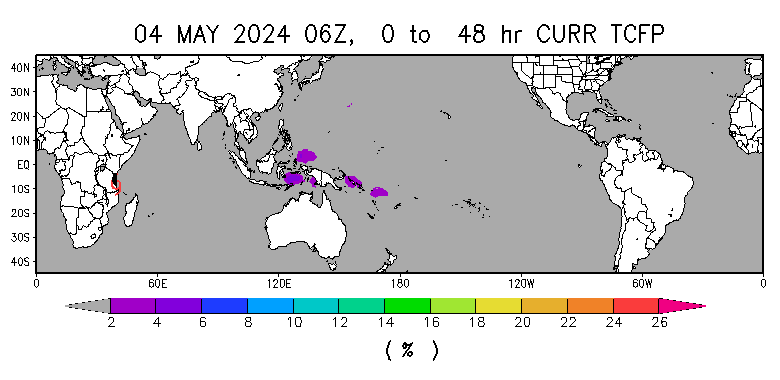
Indian Ocean Tropical Storm Risk
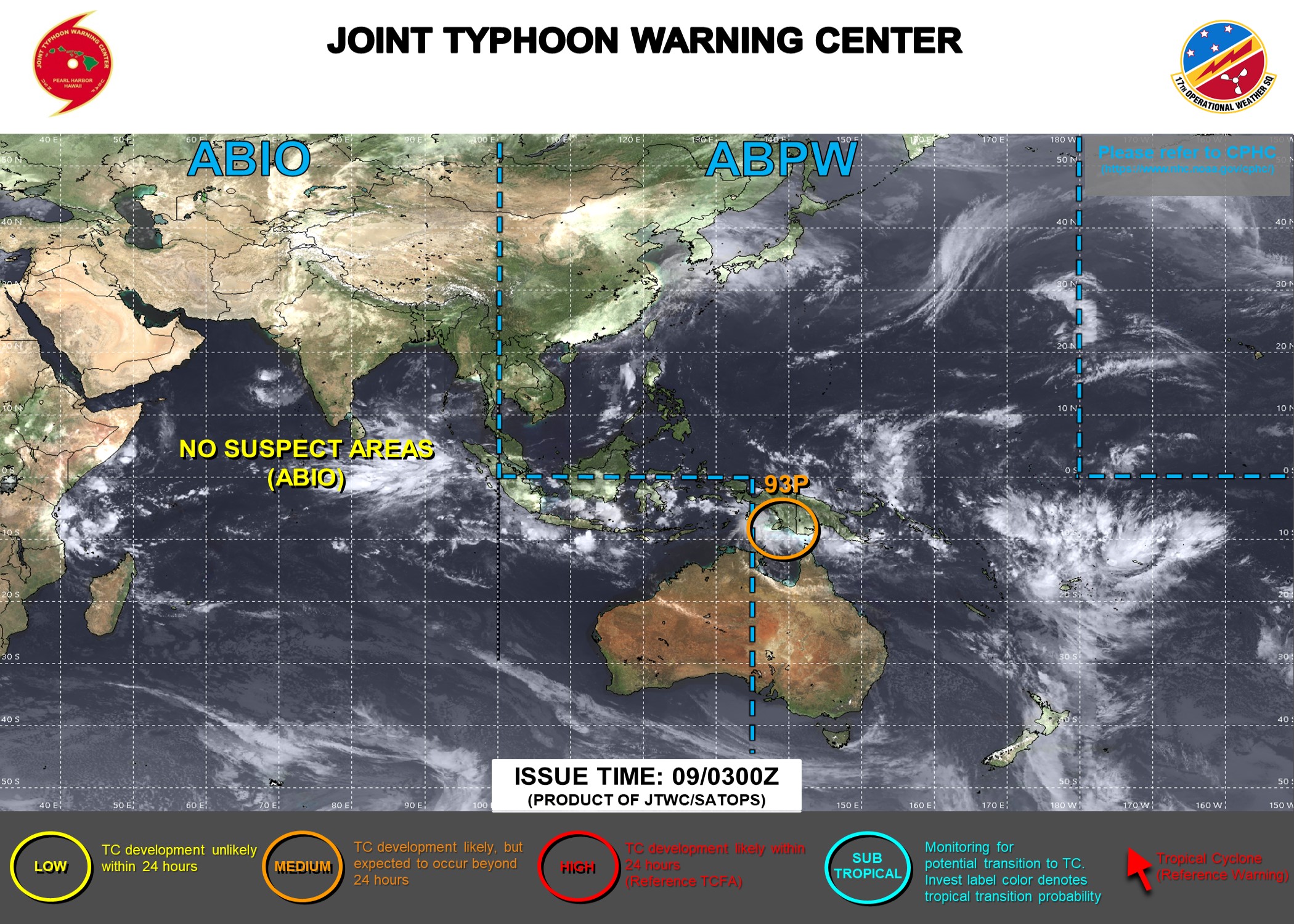
North Indian Ocean
1. NORTH INDIAN OCEAN AREA (MALAY PENINSULA WEST TO COAST OF AFRICA):
   A. TROPICAL CYCLONE SUMMARY: NONE.
   B. TROPICAL DISTURBANCE SUMMARY: NONE.
   C. SUBTROPICAL SYSTEM SUMMARY: NONE.
South Indian Ocean
2. SOUTH INDIAN OCEAN AREA (135E WEST TO COAST OF AFRICA):
   A. TROPICAL CYCLONE SUMMARY: NONE.
   B. TROPICAL DISTURBANCE SUMMARY:
      (1) THE AREA OF CONVECTION (INVEST 94S) HAS PERSISTED NEAR 10.2S
59.3E, APPROXIMATELY 400 NM SOUTHEAST OF SEYCHELLES. ANIMATED
MULTISPECTRAL SATELLITE IMAGERY (MSI) AND A 050128Z SSMIS F17 91GHZ
MICROWAVE PASS DEPICT A POORLY-ORGANIZED, ELONGATED, AND SLOWLY
CONSOLIDATING LOW LEVEL CIRCULATION CENTER (LLCC) WITH PERSISTENT DEEP
CONVECTION DEVELOPING AROUND THE LLCC. A 050515Z ASCAT-B PASS SHOWS A
HIGHLY ELONGATED CIRCULATION, WITH A NASCENT LLCC DEVELOPING IN THE
SOUTHEASTERN EXTENT OF THE ROTATION. WINDS AROUND THE CIRCULATION ARE
25-30 KNOT WINDS IN THE NORTHEAST OF THE SEMI-CIRCLE, WHILE WINDS IN
THE SOUTHWESTERN SEMICIRCLE ARE 15-20 KNOTS. ENVIRONMENTAL ANALYSIS
REVEALS A MARGINALLY FAVORABLE ENVIRONMENT FOR DEVELOPMENT WITH LOW TO
MODERATE VERTICAL WIND SHEAR (VWS) OF 15-20 KNOTS, GOOD UPPER-LEVEL
OUTFLOW, AND WARM SEA SURFACE TEMPERATURES (SST) OF 27-28C. GLOBAL
DETERMINISTIC AND ENSEMBLE MODELS ARE IN GOOD AGREEMENT IN PORTRAYING
WEAK DEVELOPMENT, WHILE 94S SLOWLY TRANSITS SOUTHWESTWARD, OVER THE
NEXT 48 HOURS. MAXIMUM SUSTAINED SURFACE WINDS ARE ESTIMATED AT 25 TO
30 KNOTS. MINIMUM SEA LEVEL PRESSURE IS ESTIMATED TO BE NEAR 1008 MB.
THE POTENTIAL FOR THE DEVELOPMENT OF A SIGNIFICANT TROPICAL CYCLONE
WITHIN THE NEXT 24 HOURS IS UPDRAGED TO MEDIUM.
      (2) NO OTHER SUSPECT AREAS.
   C. SUBTROPICAL SYSTEM SUMMARY: NONE.
back to the top Northwest Pacific and South Pacific Tropical Storm Risk
Northwest Pacific Ocean
1. WESTERN NORTH PACIFIC AREA (180 TO MALAY PENINSULA):
   A. TROPICAL CYCLONE SUMMARY:
      (1) AT 05NOV26 0600Z, TROPICAL STORM 30W (IN-FA) WAS LOCATED
NEAR 29.4N 141.5E, APPROXIMATELY 366 NM SOUTH-SOUTHEAST OF YOKOSUKA,
JAPAN, AND HAD TRACKED NORTHEASTWARD AT 20 KNOTS OVER THE PAST SIX
HOURS. MAXIMUM SUSTAINED SURFACE WINDS WERE ESTIMATED AT 60 KNOTS
GUSTING TO 75 KNOTS. SEE REF A (WTPN31 PGTW 050900) FOR THE FINAL
WARNING ON THIS SYSTEM.
      (2) NO OTHER TROPICAL CYCLONES.
   B. TROPICAL DISTURBANCE SUMMARY:
      (1) THE AREA OF CONVECTION (INVEST 99W) PREVIOUSLY LOCATED NEAR
16.0N 159.9E IS NOW LOCATED NEAR 15.6N 157.2E, APPROXIMATELY 738 NM
EAST-NORTHEAST OF GUAM. ANIMATED MULTISPECTRAL SATELLITE IMAGERY
(MSI) AND A 042103Z SSMIS F16 91GHZ MICROWAVE PASS DEPICT A POORLY-
ORGANIZED, FULLY EXPOSED WAVE FEATURE, WITH DISORGANIZED FLARING
CONVECTION TO THE NORTH AND EAST OF THE WAVE AXIS. A 042244Z ASCAT-C
PASS, SHOWS A WELL-DEFINED EASTERLY WAVE FEATURE, WITH AN AXIS ALONG
158E, MOVING RAPIDLY WESTWARD WITH ENHANCED WINDS ALONG THE NORTHERN
SEMICIRCLE WHILE LACKING A WESTERLY WIND COMPONENT EQUATORWARD THE
WAVE. ENVIRONMENTAL ANALYSIS REVEALS A MARGINALLY FAVORABLE
ENVIRONMENT FOR DEVELOPMENT WITH LOW VERTICAL WIND SHEAR (VWS) OF 5-
10 KNOTS, WEAK UPPER-LEVEL OUTFLOW, AND WARM SEA SURFACE TEMPERATURES
(SST) OF 28-29C. GLOBAL DETERMINISTIC AND ENSEMBLE MODELS ARE IN GOOD
AGREEMENT PORTRAYING SLOW CONSOLIDATION INTO A CIRCULATION CENTER,
WHILE 99W SLOWLY TRANSITS WESTWARD, OVER THE NEXT 48 HOURS. MAXIMUM
SUSTAINED SURFACE WINDS ARE ESTIMATED AT 15 TO 23 KNOTS. MINIMUM SEA
LEVEL PRESSURE IS ESTIMATED TO BE NEAR 1010 MB. THE POTENTIAL FOR THE
DEVELOPMENT OF A SIGNIFICANT TROPICAL CYCLONE WITHIN THE NEXT 24
HOURS REMAINS LOW.
      (2) NO OTHER SUSPECT AREAS.
   C. SUBTROPICAL SYSTEM SUMMARY: NONE.
South Pacific Ocean
2. SOUTH PACIFIC AREA (WEST COAST OF SOUTH AMERICA TO 135 EAST):
   A. TROPICAL CYCLONE SUMMARY: NONE.
   B. TROPICAL DISTURBANCE SUMMARY: NONE.
   C. SUBTROPICAL SYSTEM SUMMARY: NONE.
back to the top
Australia - Western Region Tropical Storm Risk
IDW10800
Australian Government Bureau of Meteorology
Western Australia

Updated Tropical Cyclone Outlook for the Western Region
Issued at 3:08 am WST on Sunday 8 May 2022
for the period until midnight WST Tuesday 10 May 2022.

Existing Cyclones in the  Western Region:

Nil

Potential Cyclones:

Tropical Cyclone Karim (36U) was located near 9.5S 90.1E at 2am WST Sunday,
just to the north of the Western Region. It is forcast to move into the region
during Sunday morning.

TC Karim will to continue moving towards the south to southeast over the coming
days. It is expected to maintain tropical cyclone intensity until it weakens in
the middle of the week, over open waters well to the west of the WA mainland.

TC Karim is expected to remain far enough west of the Cocos (Keeling) Islands
for there to be no direct impacts from this system, however shower and
thunderstorm activity should continue into early next week.

Likelihood of this system being a tropical cyclone in the Western Region on:
Monday          High
Tuesday         High


No other significant lows are expected in the region for at least the next 7
days.

Likelihood of another system being a tropical cyclone in the Western Region on:
Monday          Very Low
Tuesday         Very Low

NOTES: The likelihood is an estimate of the chance of each system being a
tropical cyclone in the Region for each day.
Very Low:     less than 5%                 Moderate:     20 to 50%
Low:          5% to 20%                    High:         over  50%

The Western Region refers to the Indian Ocean between Longitudes 90-125E and
south of 10S.


Copyright Commonwealth of Australia 2011, Bureau of Meteorology (ABN 92 637 533
532).  Users of these web pages are deemed to have read and accepted the
conditions described in the Copyright, Disclaimer, and Privacy statements
(http://www.bom.gov.au/other/copyright.shtml).
Australia - Northern Region Tropical Storm Risk
IDD10610
Australian Government Bureau of Meteorology
Northern Territory

Tropical Cyclone Outlook for the Northern Region, including the Gulf of Carpentaria
Issued at 2:15 pm CST on Saturday 30 April 2022
for the period until midnight CST Tuesday 3 May 2022.

Existing Cyclones in the  Northern Region:

Nil.

Potential Cyclones:

There are no significant lows in the region and none are expected to develop
within the next 7 days.

Likelihood of a tropical cyclone in the Northern Region on:
Sunday          Very Low
Monday          Very Low
Tuesday         Very Low


This will be the final Tropical Cyclone Outlook for the Northern Region until 1
November 2022.

NOTES: The likelihood is an estimate of the chance of each system being a
tropical cyclone in the Region for each day.
Very Low:     less than 5%                 Moderate:     20 to 50%
Low:          5% to 20%                    High:         over  50%

The area of coverage for this outlook is the Ocean area south of 9S, between
125E and 142E, including the Gulf of Carpentaria, but excluding the area around
Timor (northwest of 11S 125E, 11S 128E, 9S 128E).


Copyright Commonwealth of Australia 2011, Bureau of Meteorology (ABN 92 637 533
532).  Users of these web pages are deemed to have read and accepted the
conditions described in the Copyright, Disclaimer, and Privacy statements
(http://www.bom.gov.au/other/copyright.shtml).
Australia - Eastern Region Tropical Storm Risk
IDQ10810
Australian Government Bureau of Meteorology
Queensland

Tropical Cyclone Outlook for Coral Sea
Issued at 2:30 pm EST on Saturday 30 April 2022
for the period until midnight EST Tuesday 3 May 2022.

Existing Cyclones in the  Eastern Region:

Nil.

Potential Cyclones:

There are no significant tropical lows currently in the region and none are
expected for the next 7 days.

Likelihood of a tropical cyclone in the Eastern Region on:
Sunday          Very Low
Monday          Very Low
Tuesday         Very Low


This will be the final Tropical Cyclone Outlook for the Eastern Region until 1
November 2022.

NOTES: The likelihood is an estimate of the chance of each system being a
tropical cyclone in the Region for each day.
Very Low:     less than 5%                 Moderate:     20 to 50%
Low:          5% to 20%                    High:         over  50%

The area of coverage for this outlook is the Coral Sea and northern Tasman Sea
west of 160E.


Copyright Commonwealth of Australia 2011, Bureau of Meteorology (ABN 92 637 533
532).  Users of these web pages are deemed to have read and accepted the
conditions described in the Copyright, Disclaimer, and Privacy statements
(http://www.bom.gov.au/other/copyright.shtml).
back to the top
Fiji Tropical Storm Risk
WWPS21 NFFN 050600
TROPICAL DISTURBANCE SUMMARY FOR AREA EQUATOR TO 25S, 160E TO 120W
ISSUED FROM RSMC NADI NOV 050727 UTC.

NO SIGNIFICANT TROPICAL DISTURBANCE ANALYSED OR FORECAST IN THE AREA.
=
back to the top
Eastern Pacific Tropical Storm Risk
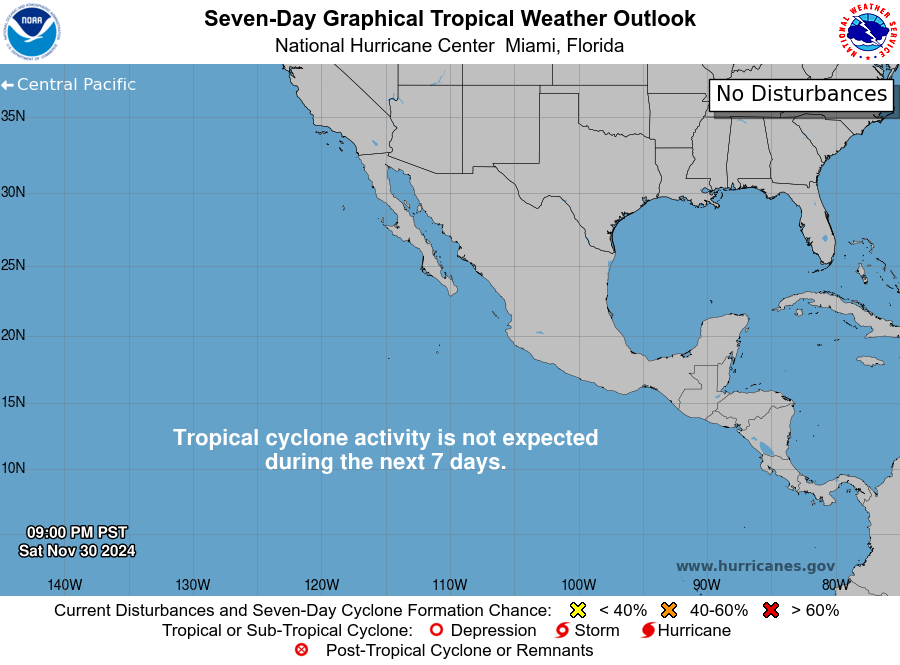
000
ABPZ20 KNHC 051146
TWOEP

Tropical Weather Outlook
NWS National Hurricane Center Miami FL
400 AM PST Thu Nov 5 2026

For the eastern and central North Pacific east of 180 longitude:

Well Southeast of the Hawaiian Islands (CP95):
Showers and thunderstorms continue to show signs of organization in
association with an area of low pressure located over the eastern
portion of the Central Pacific basin. While earlier satellite wind
data suggested the system does not yet have a well-defined
circulation, environmental conditions appear conducive for
additional development. A tropical depression is now likely to form
over the next day or so while the system moves westward to
west-northwestward at 10 to 15 mph, passing well south of the
Hawaiian Islands.
* Formation chance through 48 hours...high...80 percent.
* Formation chance through 7 days...high...80 percent.

Eastern East Pacific:
A broad area of low pressure offshore of Central America is
producing a large area of showers and thunderstorms that have not
become any better organized over the past day. Gradual development
of this system is possible during the next several days, and a
tropical depression could form by this weekend while the low drifts
slowly offshore of the Central America coast. Regardless of
development, this system could bring areas of heavy rain to portions
of Central America through this weekend.
* Formation chance through 48 hours...medium...40 percent.
* Formation chance through 7 days...medium...60 percent.

$$
Forecaster Papin
Atlantic Tropical Storm Risk
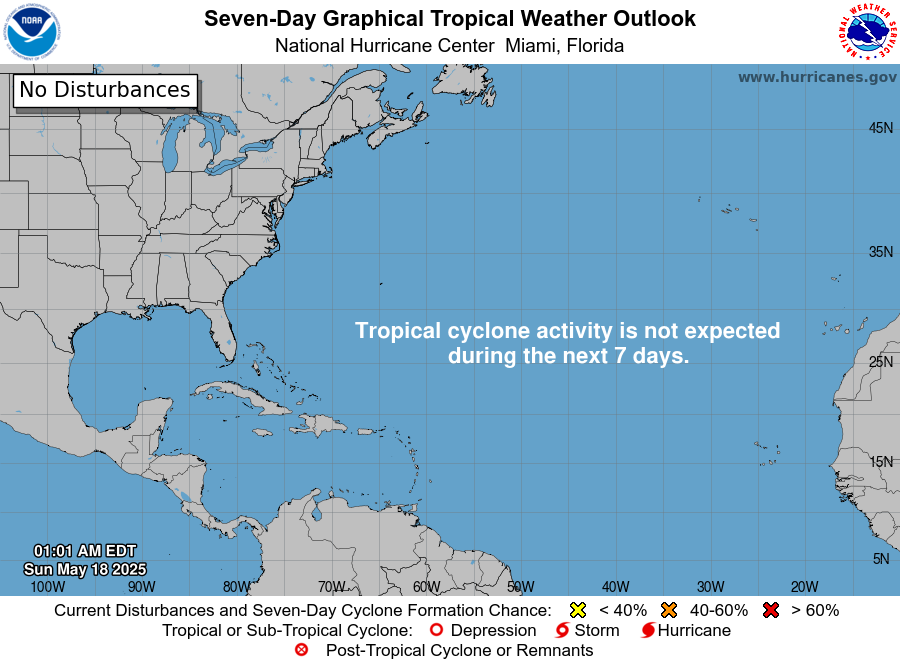
000
ABNT20 KNHC 051149
TWOAT

Tropical Weather Outlook
NWS National Hurricane Center Miami FL
700 AM EST Thu Nov 5 2026

For the North Atlantic...Caribbean Sea and the Gulf of America:

Western and Central Atlantic:
A broad, non-tropical low pressure area located a few hundred miles
south of Bermuda is producing some disorganized convection mainly to
the east of its center. Environmental conditions could support this
system gradually acquiring subtropical characteristics through this
weekend while it moves slowly eastward over the western and central
subtropical Atlantic. By early next week, environmental conditions
are forecast to become unfavorable for further development. For more
information on this system, including Gale Warnings, please see High
Seas Forecasts issued by the National Weather Service.
* Formation chance through 48 hours...low...30 percent.
* Formation chance through 7 days...medium...50 percent.

&&
High Seas Forecasts issued by the National Weather Service can be
found under AWIPS header NFDHSFAT1, WMO header FZNT01 KWBC, and
online at ocean.weather.gov/shtml/NFDHSFAT1.php

$$
Forecaster Reinhart
back to the top
Central Pacific Tropical Storm Risk
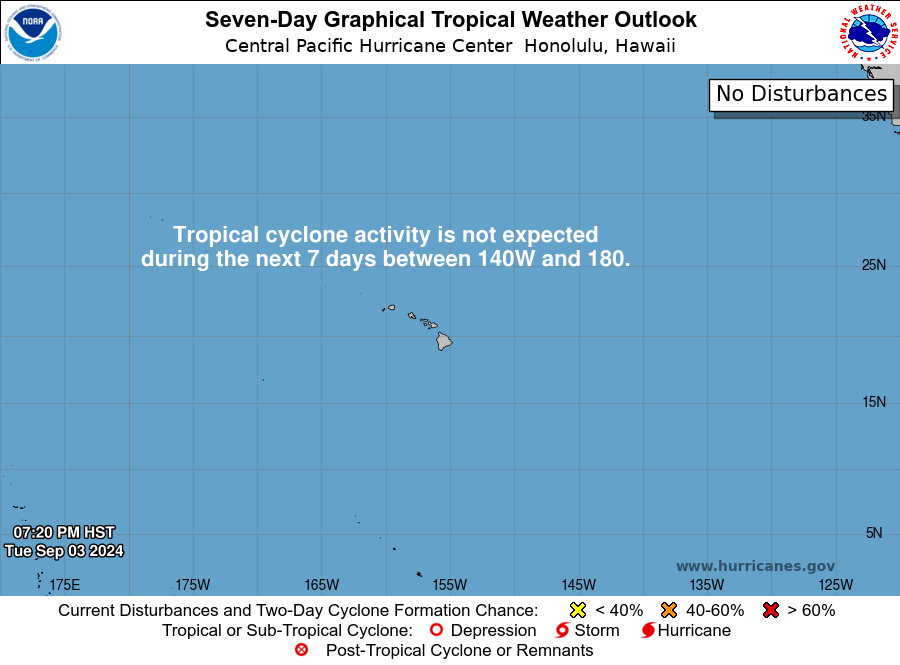
ACPN50 PHFO 051146
TWOCP

Tropical Weather Outlook
NWS Central Pacific Hurricane Center Honolulu HI
Issued by NWS National Hurricane Center Miami FL
200 AM HST Thu Nov 05 2026

For the central North Pacific...between 140W and 180W:

Well Southeast of the Hawaiian Islands (CP95):
Showers and thunderstorms continue to show signs of organization in
association with an area of low pressure located over the eastern
portion of the Central Pacific basin. While earlier satellite wind
data suggested the system does not yet have a well-defined
circulation, environmental conditions appear conducive for
additional development. A tropical depression is now likely to form
over the next day or so while the system moves westward to
west-northwestward at 10 to 15 mph, passing well south of the
Hawaiian Islands.
* Formation chance through 48 hours...high...80 percent.
* Formation chance through 7 days...high...80 percent.

$$
Forecaster Papin
NNNN
back to the top
Servicio Meteorológico Nacional - Atlantic
Servicio Meteorológico Nacional - Eastern Pacific
back to the top
site by Hayley Croft
Hi, I'm Hayley. Did you know that I run this site out of my own pocket? So if you'd like to help support this site:
- Tell your friends about Cyclocane
- Buy something through this Amazon Cyclocane link
- make a donation - totally optional but completely appreciated
Make a monthly donation or a one-time donation to help support ongoing costs with Cyclocane.
Play solitaire and track all of the cyclocane storms at the same time at Hurricane Solitaire.